TrustScaff provides independent scaffolding audits that assess not just the structure, but the contractor behind it — covering documentation, training records, safe working practices and full regulatory compliance. Serving London, Essex, Kent, Surrey, East Sussex and West Sussex.
A scaffold inspection checks that the physical structure in front of you is safe on a given day. A scaffold audit goes further — it examines the scaffolding contractor’s entire operation: their documentation, their workers’ training records, their risk assessments, their working practices and whether they are operating in line with current regulations. Both are important. They are not the same thing.
Every TrustScaff scaffolding audit follows a structured, documented process. Our CISRS accredited auditors assess both the physical site and the contractor’s management arrangements, producing a comprehensive report that gives you a complete picture of compliance.
We examine all site paperwork including risk and method statements, design drawings, TG20 compliance sheets, toolbox talk records and scaffold inspection registers — checking they exist, are current and are being properly maintained.
We verify that all scaffolding operatives on site hold valid, in-date CISRS cards appropriate to the work being carried out. Expired or insufficient cards are flagged immediately.
Our auditors observe scaffolders actively at work and assess compliance with NASC Safety Guidance SG4 — the industry standard for preventing falls in scaffolding operations.
We check that all operatives are wearing the correct personal protective equipment and that it is in suitable condition — a common failure point that exposes principal contractors to liability.
We assess whether adequate measures are in place to protect people on and around the site from falling materials, unauthorised access and other hazards created by the scaffolding operations.
We verify that all scaffolding equipment — including tubes, fittings, boards and harnesses — is properly certified, inspected under PUWER regulations and fit for purpose.
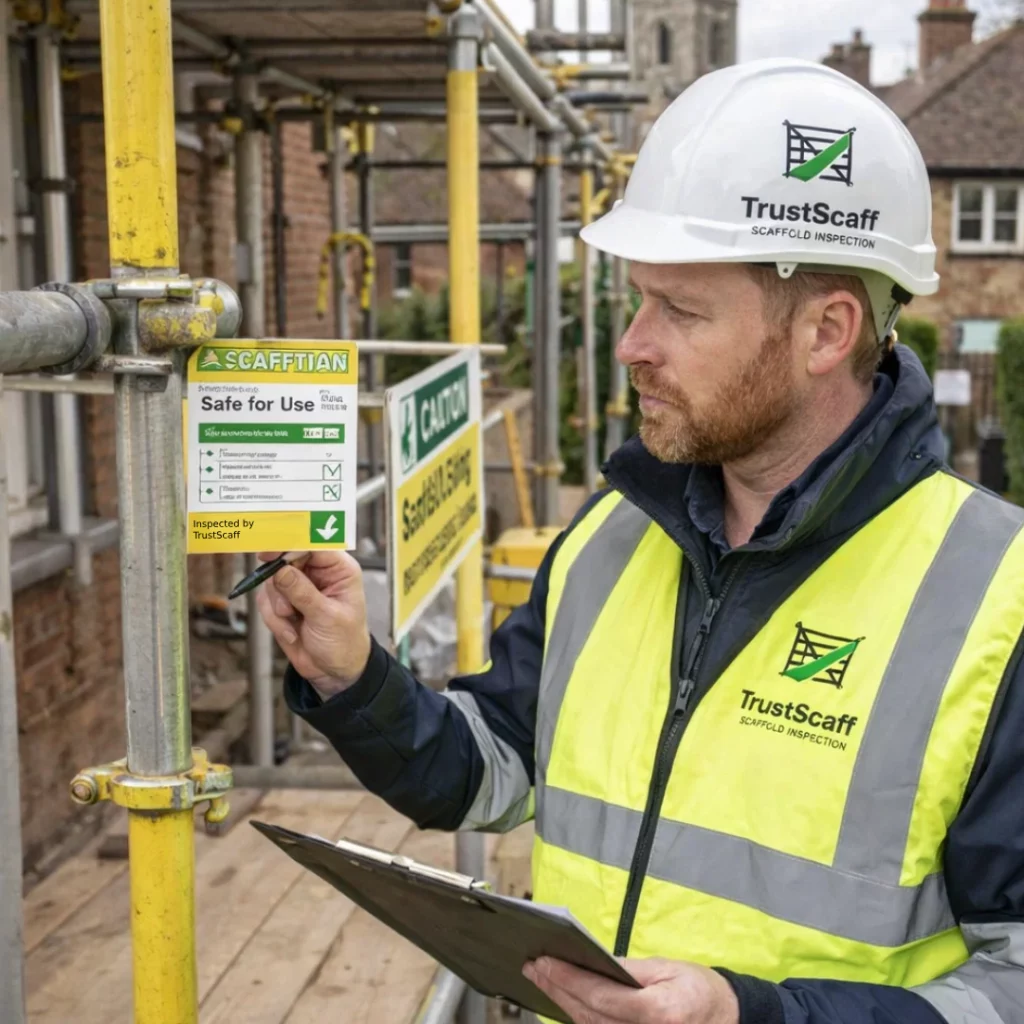
Every inspection is carried out by a fully CISRS accredited professional — not a subcontractor, not a trainee. You get qualified expertise on every visit, with the paperwork to prove it.
We know your programme doesn’t wait. Our inspectors submit digital reports the same day — so you have the documentation you need to keep work moving without unnecessary downtime.
Every report includes a full record of findings, photographs and a clear pass or remedial-action summary — ready for your site files, CDM records or housing association audits.
As an independent inspection company, TrustScaff has no vested interest in the scaffold — only in the safety and compliance of your site.
Booking a scaffolding audit with TrustScaff is straightforward. No lengthy back-and-forth, no waiting around — just a simple process designed to get a qualified auditor on your site as quickly as possible.
Ready to get started? Request your audit quote below and we’ll be in touch within two hours.
A scaffolding audit is not a specific legal requirement in the same way that a weekly scaffold inspection is. However, as a principal contractor under the Construction (Design and Management) Regulations 2015, you have a legal duty to ensure that every contractor working on your site — including your scaffolding contractor — is competent and managing their work safely. An independent scaffolding audit is one of the most effective ways to demonstrate that you have taken reasonable steps to discharge that duty. If an incident occurs and you cannot show that you took active steps to verify your scaffolding contractor's competence and compliance, your exposure to HSE enforcement action and civil liability increases significantly. In short, it may not be written into statute, but commissioning regular audits is simply sound risk management.
A scaffold inspection assesses the physical condition of the scaffold structure on a specific date — checking components, stability, guardrails and boards to confirm the structure is safe to use. It is required by law at least every seven days. A scaffold audit is a broader assessment of the scaffolding contractor's entire operation. It examines their documentation, their workers' training records and CISRS cards, their risk and method statements, their actual working practices on site, PPE conformity and whether they are operating in line with current regulations including NASC Safety Guidance SG4. Put simply, an inspection tells you whether the scaffold is safe today. An audit tells you whether the contractor responsible for it is operating safely and compliantly. Both matter, and neither replaces the other.
The duration of a scaffolding audit depends on the size and complexity of the site and the scope of the audit required. For a typical construction site with a single scaffolding contractor, a TrustScaff audit will generally take between two and four hours on site. Larger projects involving multiple scaffolding operations, extensive documentation or a more detailed supply chain assessment may take longer. We will give you a clear indication of the expected time when we confirm your booking, and the audit report will be delivered digitally the same day regardless of duration.
There is no single answer that applies to every project, but as a general guide we recommend commissioning a scaffold audit at the start of any new scaffolding contract, particularly if you are working with a contractor you have not used before. For longer-term projects or ongoing refurbishment programmes — such as housing association planned maintenance contracts — a quarterly audit programme gives you regular, documented assurance throughout the project lifecycle. For principal contractors who use the same scaffold contractors repeatedly, an annual audit per contractor as part of a supply chain review process is a practical and defensible approach. Our team can help you design an audit schedule that fits your project type and compliance obligations.
That is entirely your decision as the client, and both approaches have merit. An announced audit gives the contractor the opportunity to ensure their documentation is in order and their team is prepared — which can be useful if the primary goal is to support improvement rather than simply assess current performance. An unannounced audit gives you a more accurate picture of day-to-day working practices, since you are seeing the contractor as they operate under normal conditions rather than how they present themselves when they know they are being watched. We are happy to carry out either type and can advise on which approach is most appropriate for your specific situation and objectives.
If our auditor identifies anything that represents an immediate risk to the safety of workers or the public, we will bring it to your attention on site without delay so that appropriate action can be taken straight away. All findings — whether immediate safety concerns or longer-term compliance issues — are documented in full in the audit report, along with clear recommended corrective actions and the priority level assigned to each. You will receive the report the same day. What you do with the findings is ultimately your decision as the client, but we can also provide follow-up support, including a re-audit once corrective actions have been implemented, to confirm that the issues have been properly resolved.
Yes, and this is one of the most common reasons our clients commission a TrustScaff audit. Before appointing a new scaffolding contractor, or as part of a periodic review of your existing supply chain, an independent audit provides you with objective, documented evidence of a contractor's competence and compliance standards — evidence that carries considerably more weight than a self-completed pre-qualification questionnaire. We can work to your existing supply chain framework or help you develop an audit standard that reflects your specific requirements. If you manage multiple sites or a large contractor panel, we can also provide a programme of audits across your supply chain with consistent reporting so you can compare performance across contractors on a like-for-like basis.